The good thing can start now
When I signed up in high school to try out for the soccer team, I imagined a training montage a la Mulan would happen to me in the two months until tryouts. I had played 10 years of county rec-league soccer and I was ready to level up. Over the summer, I went for a "run" every couple of weeks, tiring into a walk after just a few minutes, and kicked around a ball by myself a few times for twenty minutes. On the first day of tryouts, by the end of the warm-up loops around the pitch, I was already panting and exhausted. I didn't go back for the second day, and when school started, my English teacher, who was also the coach of the soccer team, did me a kindness when he, intentionally or not, did not seem to recognize me.
Noticing I wanted to join a school sports team, my older sister, a varsity runner in high school, told me, "Just join cross-country! You just need a 12 minute mile to make JV."
"I can't do that." I protested.
She rolled her eyes. "You can walk a mile in 12 minutes."
"No, you can't."
I did try. I just hated running. My lungs would feel so utterly overcome I felt like I was drowning on land, and it was embarrassing that I couldn't keep up with anyone. Why do it, if I was bad at it? I preferred to sit inside and play The Sims every weekend until my mom inevitably would get fed up seeing me hunched in front of the computer and scold me to find something better to do with my time.
Fast forward to today and I'm 10 months in to being a runner. I run along a river path, among walkers, dogs, strollers. I notice the changes in trees' foliage from week to week and check in on popular rocky outcrops where Mallards and red-crested Pochard ducks and Eurasian coots gather. I am not a fast runner - I look at the bottoms of others' shoes a lot as they fly by me. I admire many calves this way.
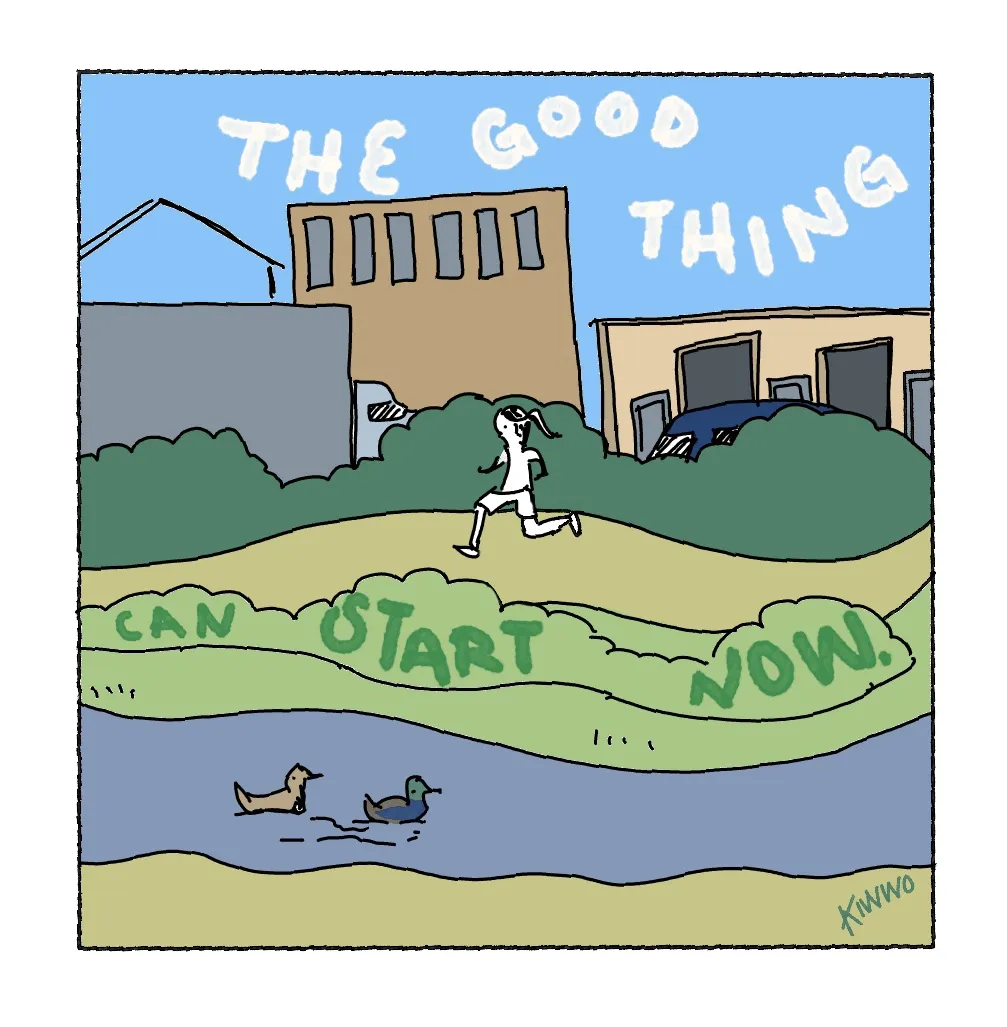
It turns out all I needed to become a runner was to move to a new country where I knew no one and needed an outlet through which to channel an enormous amount of guilt and frustration over feeling undesired by the local job market!
Just kidding - that's not all that went into it.
1. I followed a plan, but mostly to remind me to get out the door
I started out using the training program on a Garmin watch I had picked up secondhand during a previous attempt to become a runner. I told it I wanted to run a 12 minute mile by the end of 11 weeks. I didn't do every workout, and I often couldn't keep up with the pace set for me. My heartrate would explode upwards every session, but it didn't matter - the goal was just to get over the dread of going out. I reminded myself that, from evidence, I knew I had finished the last run feeling accomplished. Once I was outside, it was easier to keep going, at whatever rate.
2. I focused on adding to my gearbox.
A few months into my runs, my partner, a lifelong runner, tried to convince me to tune in to my body and what I was noticing, rather than to rely on an external device.
"All you have to do is jog, slow enough that you can talk at the same time."
This advice made zero sense to me. My gearbox truly felt like it had two settings - 0 (walking) and 100 (running for 15 seconds until I felt like my lungs were going to pop). A runner doesn't understand this and will just say it means you're going too fast - which is true but greatly oversimplified. As inexperienced a runner as I was, I knew that what was happening was that I simply did not have enough muscle, and did not have enough muscle control. An undercutting tool of peer pressure is this attitude that willpower is enough to achieve anything - you just have to want it enough, and you can do it. But you can't skip the muscle building - some things require time.
As the weeks passed by, I could feel that there was a new middle ground developing between my previous 0 and 1 - a less frenzied pace I could find before I tired out, a knowledge that I was starting to be able to control something new. Now I would say I have maybe 3 levels in my gearbox, and have the ability to attune to and appreciate what my body has to tell me during a run.
3. I needed desperately to run.
The extra energy I was whipping up in myself over the cycles of job searching, interviewing, being declined was wrecking havoc on my mood, my outlook on life, and my relationships. In the first weeks, when I would fall behind in each workout the Garmin set for me, I would just use my 2-level gearbox, 0 to 100 with nothing in between, and lurch up and down the paths until I was too gassed to remember whatever thoughts had been squirreling around in my brain twenty minutes before. It didn't matter that I wasn't fast, or that I walked. It gave me a break from myself. A lifetime cardio dreader, I finally understood why I could be a runner - I needed desperately to run, and it helped me have no expectations beyond doing the thing.
The Next Milestone
My next milestone is learning to write again. Starting a new skill is either fun or dreadful, depending on how much permission you give yourself to enjoy the process. On one end of the spectrum, if you are certain of your badness, you might not let yourself see the improvements when they come. And almost immediately, as a product of your attention and focus, they will come, though they may be small, many, almost imperceptible. In this way, I feel intimidated to begin, and take a lot of comfort from Celine Nguyen's sympathetic affirmation that "when you aspire to be better than you are, there’s no other way to do it except by starting. You’re always faking it at the start, always doing things badly."
On the other end of the spectrum is the expectation of natural talent and effortlessness (Maybe I'm actually secretly gifted at this new thing!). In some ways this expectation is a sweet form of self-confidence - but it also belies a doubt in one's ability to improve. We have to start at the top, or we are not worth the effort. In her book encouraging the creation of imperfect art as a method of self-development, Amie McNee writes, "There are so many ways we withhold permission from ourselves. A lot of the time we do it unconsciously, not even realizing we hold the power to pick ourselves.” We have to pick ourselves as a vessel of investment, a foundation to build, gears to add.
After several attempts at either end of the spectrum, I never found the joy of the process. Then I lucked out - I had so little expectation, and such great need, that I didn't have to be good for the good thing to start immediately. The training montage that I had expected as a teenager, finally arrived some 20 years later. I watched my improvement like it was someone else. It was enjoyable.
As I've surprised myself with running, I am beginning, with writing, to test my theory that the good thing can start now. Somewhere between self-doubt and self-expectation is self-acceptance. As Rebecca Solnit reminds me: "the road to good writing is made out of words and not all of them are well-arranged words."